At four in the morning, in a house somewhere south of Tokyo, a light turns on in a room where no one is expected to be awake. The room is quiet. It has been quiet since nine o'clock the previous night, when the man who lives here went to bed. He does not use an alarm clock. He has not used one in decades. His body wakes at four because his body has been waking at four for forty years, and by now the hour is not a decision but a reflex, the way a long-distance runner's stride is no longer a decision after the first five hundred miles.
The man makes coffee. He sits down. He begins to write.
He will write for five and a half hours. He will not check his phone, because there is no phone in the room. He will not read the news, because the news will still be there at noon and the novel will not wait. He will produce roughly ten manuscript pages — two thousand words, sometimes three thousand, never fewer than fifteen hundred — and when the work is done, usually around ten in the morning, he will stand up, change into running clothes, and run ten kilometers through the streets near his house, alone, without music, without a companion, without thinking about the novel he has just set down.
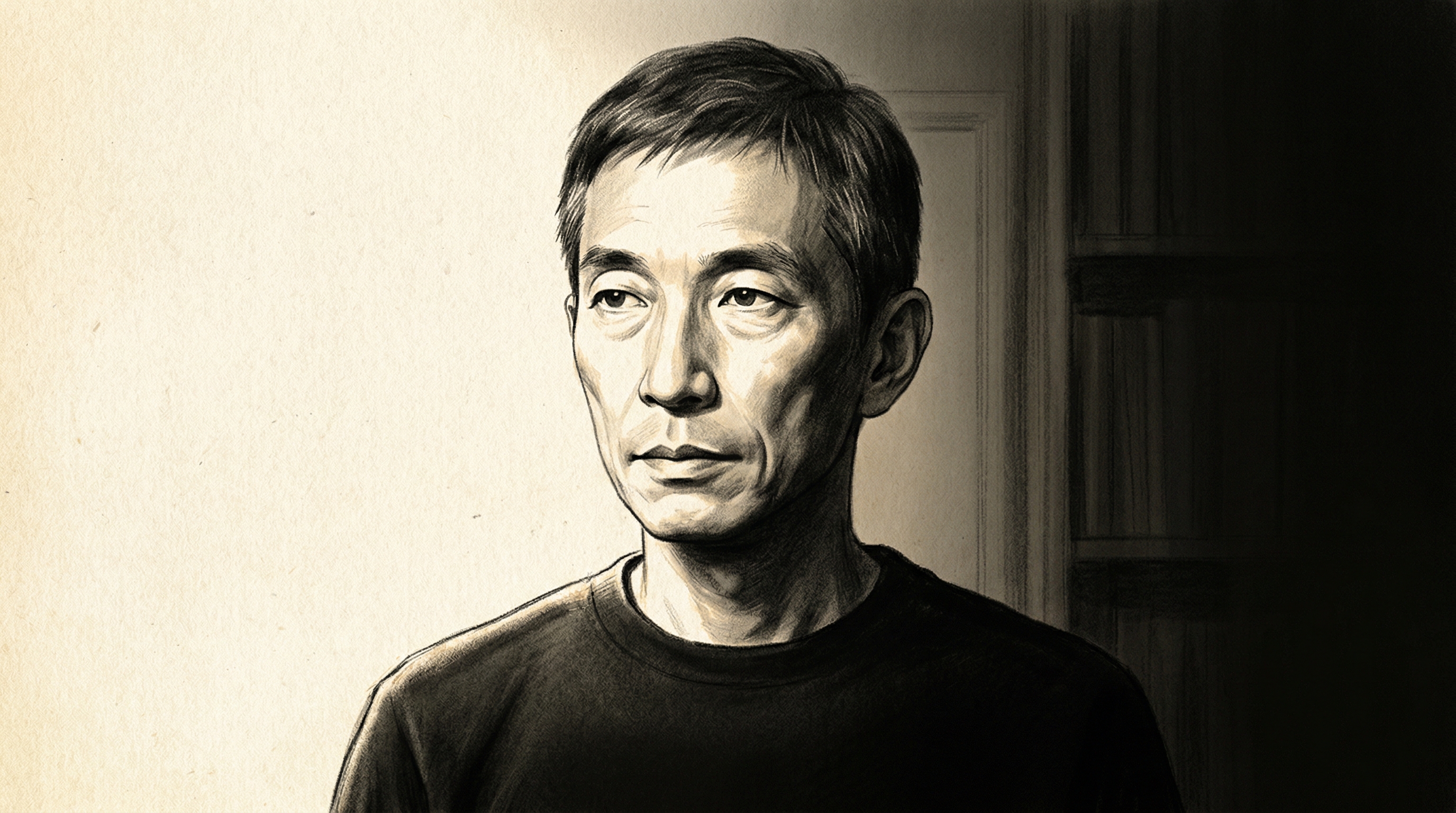
His name is Haruki Murakami. He is the most widely translated Japanese novelist alive. And the routine described above — the four o'clock wake, the five-hour writing block, the ten-kilometer run, the nine o'clock bedtime — has not changed, in any meaningful particular, since 1982.
#The jazz bar
Before there was the silence at four in the morning, there was noise.
In 1974, a twenty-five-year-old Waseda University dropout and his wife Yoko opened a jazz bar in Kokubunji, a quiet suburb west of central Tokyo. They called it Peter Cat, after their own cat. They had almost no money. Murakami mixed cocktails, made sandwiches, talked to customers, selected the records, swept the floor after closing. Yoko managed the books. The bar was open from late afternoon until past midnight, and the rhythm of their life was the rhythm of jazz — late nights, cigarette smoke, conversation with strangers, and a kind of beautiful disorder that is very difficult to write novels inside.1
Murakami smoked sixty cigarettes a day. He drank. He slept late. He had a wide circle of friends who lived the same way — musicians, bartenders, night people. He was, by every external measure, the opposite of the man who would later wake at four and run ten kilometers before lunch.
The bar moved to Sendagaya in central Tokyo around 1977. It was doing well. Murakami was twenty-eight, and he had no intention of writing a novel. Then a baseball game changed everything.
#April 1, 1978
He tells the story the same way every time, in every interview, because the story does not need to change. He was sitting in the outfield bleachers at Meiji Jingu Stadium, watching the Yakult Swallows play the Hiroshima Carp. It was a warm afternoon. In the bottom of the first inning, the American player Dave Hilton hit a clean double to left field. The ball sailed over the grass. And in that instant — Murakami has never been able to explain why, and has stopped trying — he knew with absolute clarity that he could write a novel.2
He went home that night, closed the bar, and sat down at the kitchen table. He wrote the first pages of Hear the Wind Sing in the hours before dawn, in the only silent time available to a man who ran a jazz bar. It took six months. It won the Gunzo Literature Prize. It appeared in book form in July 1979.
He kept running the bar for three more years, writing novels in the margins of the night. In 1981 he sold Peter Cat. In 1982 he quit smoking — sixty cigarettes, cold. He started running. He overhauled his diet: fish and vegetables, almost no alcohol, no meat. He went to bed at nine o'clock.
He became his own Emma — the term this series uses for the person, the place, or the discipline that holds the architecture around the work. Darwin's Emma was his wife, who held every hour of his day in place for forty years. Hemingway's was a Cuban farm he bought with book royalties and lost in a revolution. Murakami's was himself.
#The mesmerism
What Murakami built between 1982 and 1984 — the two years in which the bar owner became the monk — is the most radical case of self-architecture in modern literary history. Darwin had Emma. Hemingway bought his with four marriages and a Cuban farm. Murakami had no one to hold the structure for him. So he became the structure.
The schedule, as he described it to the Paris Review in 2004, is worth quoting in full because of how little it contains:
"When I'm in writing mode for a novel, I get up at four a.m. and work for five to six hours. In the afternoon, I run for ten kilometers or swim for fifteen hundred meters (or do both), then I read a bit and listen to some music. I go to bed at nine p.m. I keep to this routine every day without variation."3
Every day without variation. For the duration of a novel — six months, a year, sometimes two years. Then a brief interlude. Then the next novel. For forty years.
The word Murakami uses for what this routine does to him is mesmerism. Not discipline, not willpower, not structure. Mesmerism — the state you enter when a repetition has gone on so long that it stops being a repetition and becomes a trance.
"The repetition itself becomes the important thing," he told the same interviewer. "It's a form of mesmerism. I mesmerize myself to reach a deeper state of mind. But to hold to such repetition for so long — six months to a year — requires a good amount of mental and physical strength. In that sense, writing a long novel is like survival training. Physical strength is as necessary as artistic sensitivity."4
This is why he runs. Not for health. Not for weight control. Not because a doctor told him to. He runs because the novel requires the body to hold up for a year of identical days, and the body will not hold up unless it is trained the way a marathon runner's body is trained — slowly, steadily, over thousands of repetitions, until the thing that was once painful becomes automatic.
"Most of what I know about writing I've learned through running every day," he wrote in What I Talk About When I Talk About Running. The sentence sounds like a metaphor. It is not a metaphor. It is a precise description of a method.5
#The hierarchy
In the same memoir, Murakami offers the clearest account any working novelist has ever given of what the craft actually requires. He ranks the qualities in order.
First, talent. "No matter how much enthusiasm and effort you put into writing, if you totally lack literary talent you can forget about being a novelist. This is more of a prerequisite than a necessary quality."
Second, focus. "The ability to concentrate all your limited talents on whatever's critical at the moment. Without that you can't accomplish anything of value."
Third — and this is the one he cares about — endurance. "What's needed of the writer of fiction — at least one who hopes to write a novel — is the energy to focus every day for half a year, or a year, or two years."6
Then the turn: "Fortunately, these two disciplines — focus and endurance — are different from talent, since they can be acquired and sharpened through training."
This is the argument of the whole book, and the argument of Murakami's life: talent is given, but focus and endurance are built. You build them the same way you build a marathon — one day at a time, without drama, without inspiration, without waiting for the moment to feel right. You sit at the desk at four in the morning because you sat at the desk at four in the morning yesterday, and the day before, and the day before that, until sitting at the desk at four in the morning is no longer something you do but something you are.
#The cost
Becoming your own Emma is the most admired form of the arrangement and, in some ways, the loneliest.
When Murakami sold the bar and remade his life, his friends did not follow. "I actually lost a lot of friends when I made the change," he told Roland Kelts. "They just couldn't understand and got angry. You know, nightlife is kind of an illusion."7
The sentence is delivered without self-pity, which makes it land harder. The people who had shared his life for a decade — the musicians, the drinkers, the late-night talkers at Peter Cat — could not inhabit the new schedule. They were not angry because Murakami had become famous. They were angry because he had become someone who went to bed at nine o'clock. The schedule did not merely change his hours. It changed who could be near him.
This is the structural cost of the internal Emma, and it is different from Darwin's or Hemingway's. Darwin lost nothing socially — Emma held the household, and the children adapted. Hemingway lost everything when the Finca was taken, but his social world survived until the architecture failed. Murakami lost the social world by building the architecture. The monastery was the cost.
Yoko stayed. She runs the contracts, the scheduling, the correspondence — the operational infrastructure of a literary career that spans fifty languages. But Yoko is not Murakami's Emma the way Emma Darwin was Darwin's. Emma held the architecture of her husband's day. Yoko handles the logistics of a career. The architecture itself — the 4 AM wake, the 10 km run, the 9 PM bed — is held by Murakami alone. He is the monk and the monastery. The abbot and the wall.
#Pain is inevitable
There is a line in What I Talk About When I Talk About Running that Murakami presents as a runner's motto but that reads, in the context of his whole life, as something closer to a creed:
"Pain is inevitable. Suffering is optional."8
The internal Emma is painful. It requires giving up the flexibility that most people consider freedom. You cannot go to a friend's dinner party on a Tuesday night because you will be in bed at nine. You cannot travel spontaneously because the routine does not travel. You cannot drink a second glass of wine because the body that runs ten kilometers every morning cannot absorb what the body that smoked sixty cigarettes could absorb without thinking.
But pain, Murakami argues, is not the same as suffering. Pain is the sensation of the thing you chose — the alarm at four, the miles in the rain, the desk when the sentences will not come. Suffering is what happens when you resist the pain instead of accepting it as the price of the work. The internal Emma eliminates suffering by making the pain so routine, so deeply embedded in the body's expectations, that it no longer registers as a choice. It registers as weather. You do not suffer from weather. You just live in it.
#The question the internal Emma cannot answer
Murakami's model is the one most modern productivity writing admires. It is clean, individual, scalable, and democratic — it requires no Victorian wife, no Cuban farm, no staff of servants. Anyone can go to bed at nine. Anyone can wake at four. Anyone can run.
Except, of course, that almost no one can.
The internal Emma works only when the life around it permits total control. Murakami has no children. His wife handles every external obligation. He has the financial freedom, earned over decades of bestselling novels, to say no to everything that would interrupt the routine. He built the monastery, but he built it inside a life that had very few competing claims on its hours.
Most people do not live inside that kind of freedom. They have children who wake at three in the morning. They have partners whose schedules are not negotiable. They have jobs that start at eight and end at six and leave no room for a ten-kilometer run before lunch. They have bodies that do not respond to training the way a healthy novelist's body does. For them, the internal Emma is an aspiration, not an architecture — admirable and, in its purest form, inaccessible.
Which raises the question that the next portrait in this series takes up: what do you do when you cannot become your own Emma and cannot find one inside your household? What kind of architecture can you build when the only material available is a room you don't own, for a few hours a day, in a city that does not care whether you write or not?
Maya Angelou's answer was the most radical of the five. She rented her Emma by the month.
Read on: Nothing on the Walls.
#References
#Footnotes
-
Murakami, H. (2008). What I Talk About When I Talk About Running. Trans. Philip Gabriel. Alfred A. Knopf. The Peter Cat years and the transition to full-time writing are described across multiple chapters. See also Bailey Richardson's account of the bar in Art Dogs (2023). ↩
-
Ibid., pp. 1-4. The Jingu Stadium origin story — Dave Hilton's double, the sudden clarity — is told in the memoir and recounted identically in the Paris Review interview and numerous others. Murakami has never embellished it. ↩
-
Murakami, H., interviewed by John Wray (2004). "The Art of Fiction No. 182." The Paris Review, Issue 170, Summer 2004. ↩
-
Ibid. The "mesmerism" passage follows immediately after the schedule description in the same interview. ↩
-
Murakami, H. (2008). What I Talk About When I Talk About Running. Trans. Philip Gabriel. Alfred A. Knopf, p. 82. ↩
-
Ibid., pp. 78-80. The talent/focus/endurance hierarchy is presented in the chapter on training and concentration. ↩
-
Murakami, H., interviewed by Roland Kelts. Cited in Kelts, R. (2007). Japanamerica. Palgrave Macmillan. The "nightlife is kind of an illusion" quote appears in multiple forms across different interviews. ↩
-
Murakami, H. (2008). What I Talk About When I Talk About Running. Trans. Philip Gabriel. Alfred A. Knopf, p. 4. ↩