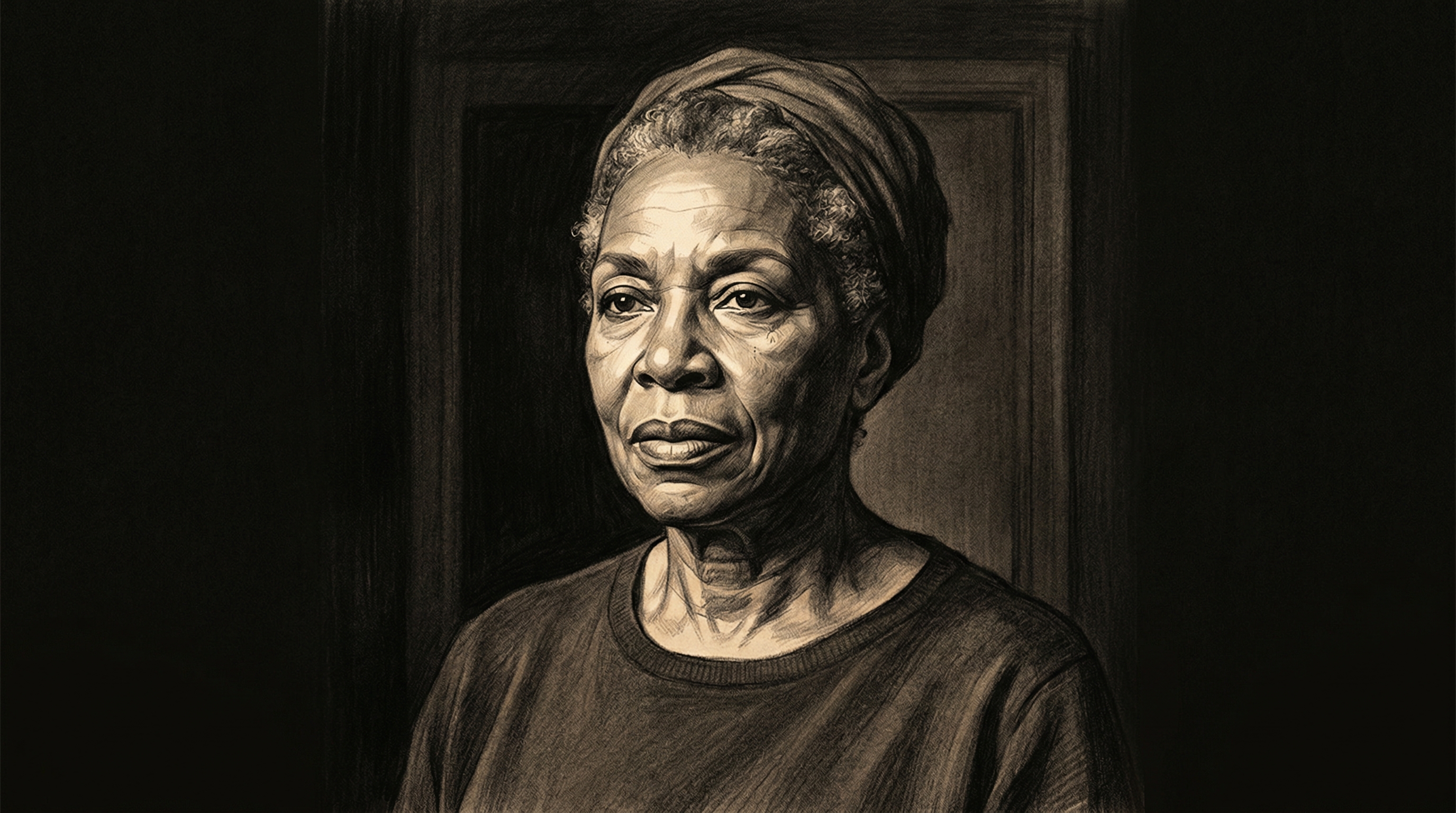
At six-thirty in the morning, a woman walks into a hotel room that she has rented by the month and will never sleep in. The walls are bare. She has asked the hotel, as she asks every hotel, to take down the paintings. The bedspread is wrinkled from yesterday; she has told housekeeping not to come. On the nightstand there are five objects: a yellow legal pad, a Bible, Roget's Thesaurus, a deck of playing cards, and a bottle of sherry. Nothing else. No phone, no clock, no photographs, no mail. The window is shut. The room could be in any city in the world, and across forty-five years, it was.
She lies down across the bed on her side, prop herself on one elbow, opens the legal pad, and begins to write. By the time she leaves — around one in the afternoon, sometimes earlier — she will have produced ten or twelve pages in longhand. By evening, after a careful edit at her kitchen table, those pages will be three or four. The rough pages are the ore. The finished pages are the metal. The room is the mine.
Her name is Maya Angelou. She did not publish her first book until she was forty-one years old. The method described above produced seven autobiographies, six poetry collections, a Presidential Inaugural poem, and some of the most widely quoted prose in the English language. She maintained it from 1968 until her death in 2014.
#Forty-one years before the first book
Before there was a hotel room with nothing on the walls, there was a life with everything in it.
Angelou became a mother at sixteen. To support her son Guy she worked as a Creole cook, a cocktail waitress, a calypso singer who cut a record, a nightclub dancer, an actress in the European touring company of Porgy and Bess, a journalist in Cairo, and the Northern Coordinator of Martin Luther King Jr.'s Southern Christian Leadership Conference.1 She spoke six languages. She had been poor, intermittently homeless, occasionally desperate, and once — documented without flinching in Gather Together in My Name — a sex worker in San Diego.
She did not lack ambition. She lacked the one thing that Darwin and Hemingway and Murakami all had when they built their working architectures: she lacked a life that could be organized around the writing. Darwin's wife held the household. Hemingway bought a farm. Murakami had no children and a wife who ran every external obligation. Angelou had a son, a full teaching load, a public life that included advising two presidents, and — for much of her career — no partner, no staff, and no inherited money.
She could not be her own Emma. The life was too full, too populated, too insistent. She could not find an Emma inside her household — there was no one else to hold the hours. She could not buy one — she had no Cuban farm, no Finca, no seventeen hectares.
So she rented one. By the month.
#The room
The Paris Review interview — George Plimpton, 1990 — is the primary document. Angelou described the practice with the precision of a woman who had thought about it for twenty years:
"I have kept a hotel room in every town I've ever lived in. I rent a hotel room for a few months, leave my home at six, and try to be at work by six-thirty. I stay until twelve-thirty or one-thirty in the afternoon, and then I go home and try to breathe; I look at the work around five; I have an orderly dinner — proper, quiet, lovely dinner; and then I go back to work the next morning."2
The room was not a retreat. It was an instrument.
She instructed every hotel to strip the walls bare. "I insist that all things are taken off the walls. I don't want anything in there." When Plimpton asked why, she answered with the clarity that made her prose what it was: "I just want to feel and then when I start to work I'll remember."3
Consider what this means. The paintings are removed because paintings are someone else's feelings. The phone is absent because the phone is someone else's schedule. The photographs are gone because the photographs are someone else's memory. What remains in the room is Angelou's mind, a legal pad, and the five objects she chose — each one functional, none decorative.
The Bible was not for faith. It was for sound. "The language of all the interpretations, the translations, is musical, just wonderful," she said. "I read the Bible to myself; I'll take any translation, any edition, and read it aloud, just to hear the language, hear the rhythm, and remind myself how beautiful English is."4
The sherry was not for pleasure. It was for marking. She might drink a glass at six-fifteen in the morning or at eleven — the sherry was a timestamp, a small ritual inside the larger one.
The cards were not for entertainment. They were for the gaps between sentences — the moments when the mind needed to idle without drifting toward anything that would pull it out of the work.
Every object in the room had a job. Nothing in the room was accidental. The room itself was a machine for writing, rented by the month, reproducible in any city, and Angelou ran it for forty-five years.
#She wrote lying down
This is the detail that makes the practice feel real across the decades. She lay across the hotel bed on her side, propped on one elbow, the legal pad on the mattress, writing in longhand. She did this for six hours a day. Her elbow, she told Plimpton, was "absolutely encrusted" with calluses — "just so rough."5
The posture was not comfort. It was an architecture of separation. You do not answer a phone lying on your side. You do not manage a household from a hotel bed. You do not teach a class, advise a president, or cook dinner for your family from that position. The only thing you can do, lying on your side with a legal pad, is write. The body's position enforced what the bare walls could not: the absolute exclusion of everything that was not the work.
Ten to twelve pages of rough prose in the morning. Three to four finished pages after the evening edit. Across a year, a book. Across forty-five years, a body of work that includes I Know Why the Caged Bird Sings, And Still I Rise, and On the Pulse of Morning — the poem she read at Bill Clinton's inauguration in January 1993, the first inaugural poem since Robert Frost's in 1961.
#The dare
The first book almost didn't happen. In 1968, at a dinner party in New York, the writer James Baldwin introduced Angelou to Robert Loomis, an editor at Random House. Loomis, nudged by the cartoonist Jules Feiffer's wife Judy, eventually called Angelou and suggested she write her autobiography. She declined. She had never written a book. She was forty years old.
Loomis — who understood his author before she did — tried a different approach. He told her it was "just as well, because to write an autobiography as literature is just about impossible."6
Angelou, who was constitutionally incapable of declining a challenge, began writing that week. I Know Why the Caged Bird Sings was published the following year. She and Loomis worked together for the next forty years.
#The rented Emma
This is the fourth answer in a series about the architecture that holds creative work — what this series calls an Emma, after Darwin's wife, who held the structure of her husband's working day so his failing body did not have to. Darwin's Emma was external: a person inside the household, loving and irreplaceable. Hemingway's was bought: a farm, a staff, a series of wives, all funded by book royalties. Murakami's was internal: a self-imposed monastic discipline that only works when the life around it permits total control.
Angelou's was rented.
She could not have any of the other three. She did not have a partner who would organize the household around her limits. She could not buy a farm or hire a staff. She could not become her own Emma — the life was too full of competing obligations that could not be refused. A son to raise. Students to teach. A public voice that two presidents and a nation asked to speak.
What she could do was rent a small room, pay by the month, ask the hotel to remove the paintings, bring five objects, and lie across the bed for six hours every morning. The rented Emma is the architecture of last resort — the form you build when every other form has been closed to you by circumstance. It is also, of the five types in this series, the most democratic. You do not need a Victorian marriage. You do not need money for a Cuban farm. You do not need the monastic control of a childless novelist. You need a room, a few months' rent, and the willingness to strip the walls.
#The cost of renting
The rented Emma is accessible, but it is not free.
The cost is not only money — though Angelou paid for the room across decades, and the cumulative expense was real. The cost is also the daily leaving. Every morning, Angelou walked out of her life and into a room that contained none of it. She walked past her son's bedroom, past the kitchen where dinner would later need to be made, past the desk where her teaching work waited. The walk to the car, the drive to the hotel, the insertion of the key — these were not logistics. They were daily acts of separation from a life that would have consumed every hour if she had let it.
The rented Emma is fragile in a way the other four are not. Darwin's Emma was held in place by love and by forty years of marriage. Hemingway's was held by money and by Cuban stability. Murakami's is held by a body that can still run ten kilometers. Angelou's was held by nothing more than a lease. If the hotel closes, the Emma is gone. If the money runs out, the Emma is gone. If the city changes and the room is no longer available, the Emma is gone. It is the most portable of the five architectures, and the most contingent.
And yet it lasted forty-five years — longer than Hemingway's Finca, longer than Darwin's years at the desk, longer than Murakami has been running so far. The fragility of the container did not prevent the work. It may have sharpened it. Angelou wrote with the intensity of a person who knew that the room was borrowed, that the hours were finite, and that the work would have to be good enough to justify the leaving.
#The sharpness
People who called Angelou a natural writer — who assumed the prose came easily because it read easily — did not understand what happened in the room. She wanted, she said, to grab such critics "by the throat and wrestle to the floor."
"It takes me forever to get it to look so easy," she told Plimpton. "I work at the language."7
This is the sentence that connects all five figures in this series. Darwin worked at the argument. Hemingway worked at the sentence. Murakami works at the endurance. Angelou worked at the sound — the rhythm, the musical structure, the sharpness that makes language jump off the page and into the reader's body. None of them were natural. All of them built an architecture that made unnatural concentration possible for long enough to produce a body of work.
The question is always the same: who, or what, holds the architecture?
One answer remains. The final figure in this series did not build his Emma, did not buy it, did not become it, did not rent it. He found it already waiting for him in the place where he was born — and when the world offered him every reason to leave, he refused.
Read on: The Island He Refused to Leave.
#References
#Footnotes
-
Angelou's pre-literary career is documented across her seven autobiographies and in Marcia Ann Gillespie, Rosa Johnson Butler, and Richard A. Long (2008). Maya Angelou: A Glorious Celebration. Doubleday. The SCLC role is described in The Heart of a Woman (1981). ↩
-
Angelou, M., interviewed by George Plimpton (1990). "The Art of Fiction No. 119." The Paris Review, Issue 116, Fall 1990. ↩
-
Ibid. The "I insist that all things are taken off the walls" passage follows immediately after the schedule description. ↩
-
Ibid. The Bible-as-instrument passage. Angelou was explicit that the Bible served a literary purpose — tuning her ear to the rhythms of English prose. ↩
-
Ibid. The callused elbow detail. Plimpton noted the physical evidence of the practice. ↩
-
The Robert Loomis dare is recounted in multiple sources, including Angelou's own later interviews and in Gillespie, Butler, and Long (2008). Loomis was Angelou's editor at Random House for the rest of his career. ↩
-
Angelou, M., interviewed by George Plimpton (1990). "The Art of Fiction No. 119." The Paris Review, Issue 116, Fall 1990. The full quote: "I try to pull the language in to such a sharpness that it jumps off the page. It must look easy, but it takes me forever to get it to look so easy. I work at the language." ↩